Land Rover
“The Vanishing Game”
My Contribution
Engagement Type
Case Study
Turning a Novel into an Interactive Experience
Land Rover set out to reinforce its heritage of adventure through something more immersive than a traditional automotive campaign: an original William Boyd thriller transformed into an interactive digital experience.
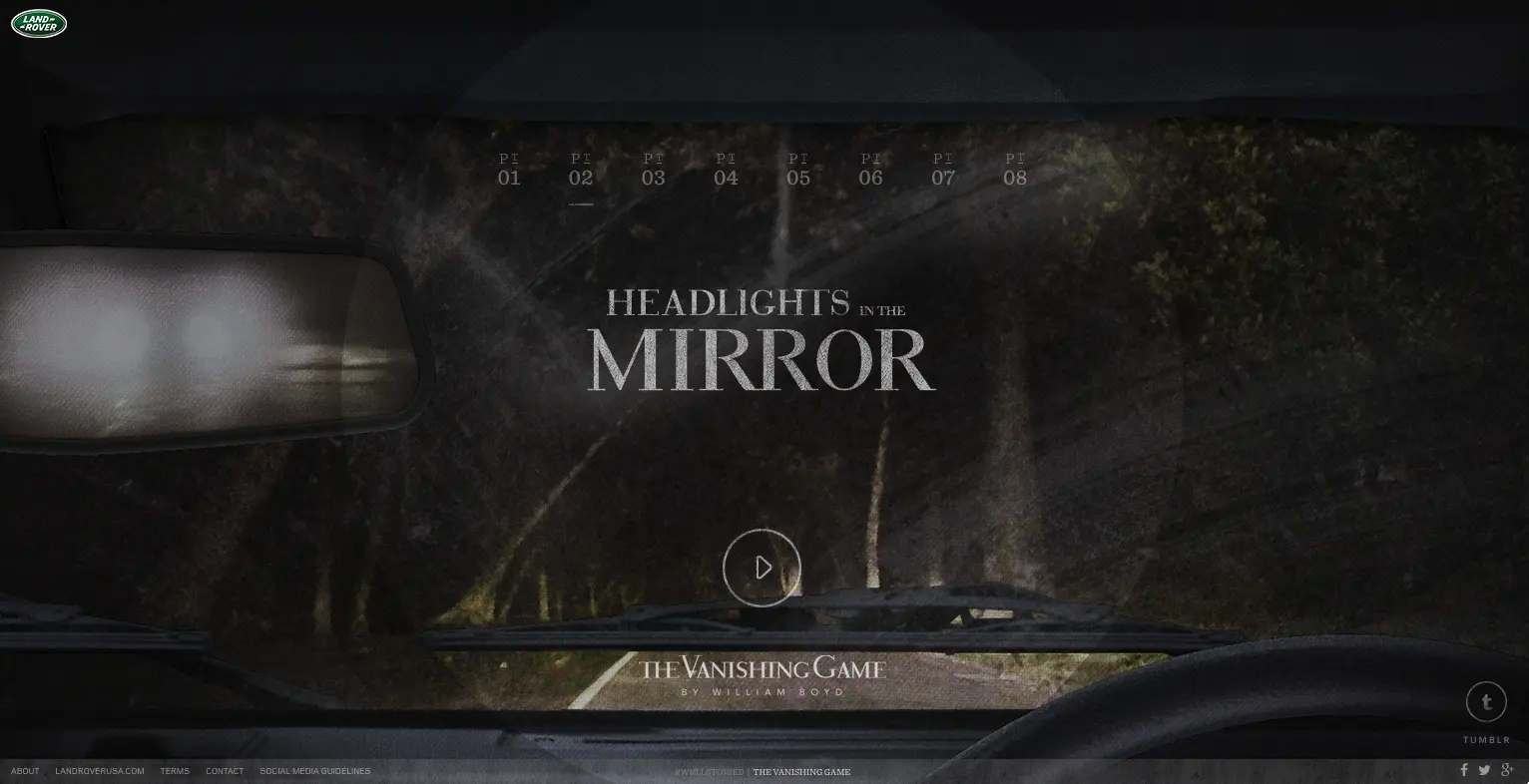
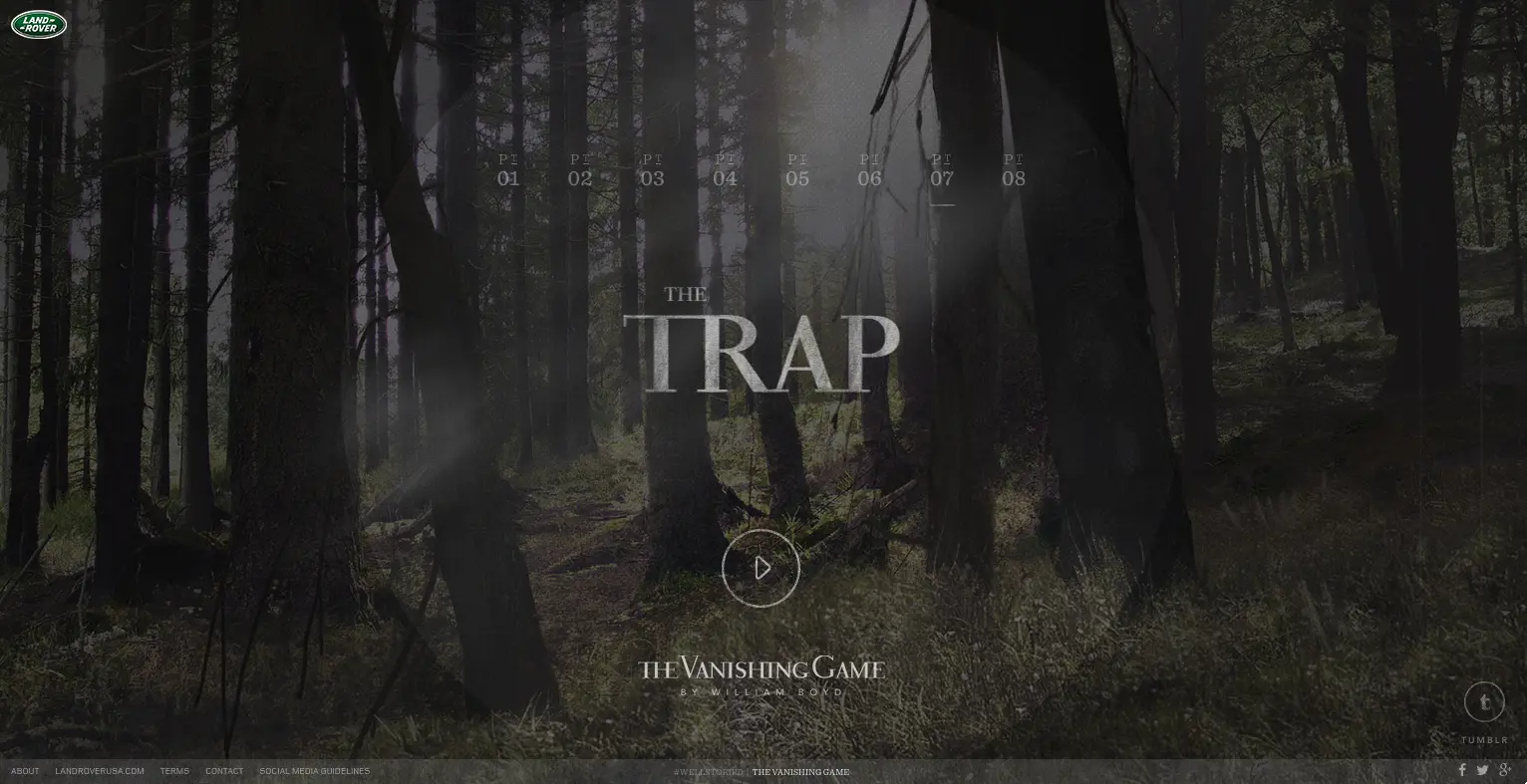
The Vanishing Game followed struggling actor Alec Dunbar on a journey from London into remote Scotland, using Land Rover as part of a larger story about exploration, uncertainty, and adventure. Rather than simply publishing the story online, the experience combined Boyd’s writing with live action, photography, illustration, animation, narration, music, sound, and interactive moments across eight chapters.
Readers could control different layers of the narrative, including narration and media, while selected moments connected the fictional story with real adventures shared by Land Rover owners. The result blurred the boundaries between digital publishing, branded entertainment, and interactive storytelling.
Building for a Media-Heavy Experience
Behind the narrative was a substantial digital delivery challenge. The experience brought together hundreds of video, photographic, illustrative, animated, and audio assets, all of which needed to perform reliably across desktop, tablet, and mobile devices.
I managed the development portion of the project in tandem with the lead developer, with my primary responsibility centered on infrastructure, technical delivery, quality, and production readiness. I also participated directly in meetings with Land Rover stakeholders to present work, detail requirements, and help keep the technical execution aligned with the experience being developed.
The application team used React with JSX for interface development alongside JavaScript and CSS3. This was an early production use of React, which had only recently been open-sourced, and its virtual DOM provided an effective foundation for an interface containing extensive animated and interactive behavior. I did not lead the application coding itself; my work focused on creating the systems and delivery environment that allowed the application and its large media footprint to operate reliably.
Engineering the Delivery Platform
With so much media supporting the narrative, storage and delivery were fundamental parts of the product rather than secondary infrastructure concerns. I designed and built the AWS architecture used to store and serve those assets, using Amazon S3 as the media origin behind a CloudFront distribution for global delivery.
I also installed and configured the LAMP environment serving the application and helped develop the approach for storing and serving the large volume of production assets arriving from the creative teams. I was not responsible for selecting or creating that content. My responsibility was helping ensure that the finished assets could be integrated, distributed, and delivered efficiently as part of the digital experience.
Preparing the platform for release included caching strategy, CDN testing, load testing, capacity planning, browser-performance work, and monitoring. I designed and carried out that work to validate how the experience would behave under production conditions and identify issues before launch.
Automating the Path to Production
I also designed, built, and tested the project’s continuous-deployment pipeline. Gulp.js was used to build and compile the application source, while I created the Bash-based deployment automation connecting successful continuous-integration builds and Git pushes to the deployment process.
The pipeline was my own architecture and implementation. Automating that path reduced the amount of manual intervention required to move builds toward production and created a more repeatable process for a project where application development, media integration, QA, and optimization were progressing simultaneously.
This was particularly valuable as the experience approached release. With multiple technical and creative dependencies moving at once, a predictable deployment process made it easier to test integrated builds, address issues, and prepare production releases without turning each deployment into a separate engineering exercise.
Performance, Quality & Launch
My responsibility extended through QA and production launch. I oversaw testing from the technical side, worked with the development team on issues discovered during QA, and personally managed the performance and infrastructure testing required to prepare the experience for release.
For a product this media-heavy, launch readiness meant more than confirming that features worked. It required validating caching behavior, CDN delivery, capacity, browser performance, infrastructure stability, and the interaction between the application and hundreds of supporting assets.
I was responsible for the production deployment and supported the experience when it went live. That ownership connected the work I had done throughout the project, from infrastructure architecture and development oversight through performance testing, QA, deployment automation, and launch operations.
Impact & Recognition
Launched in November 2014, The Vanishing Game became the centerpiece of a broader Land Rover campaign that extended across digital publishing, social media, editorial partnerships, and other channels. The broader campaign ultimately generated more than 100,000 e-book downloads through Amazon.
The experience also received significant industry recognition for its combination of storytelling, design, technology, and branded entertainment, including a One Show Bronze Pencil and Clio Bronze, alongside recognition from ADC, Awwwards, FWA, the Webbys, and other industry organizations.
Recognition
Additional recognition included: One Show Bronze Pencil for Branded Entertainment / Custom Content, Clio Bronze for Branded Entertainment / Digital, Awwwards Site of the Day, FWA recognition, Webby recognition, and London International Awards finalist honors.
For me, The Vanishing Game represents an important evolution from hands-on development into broader technical delivery leadership. I worked alongside the lead developer rather than serving as the primary application developer, while taking ownership of the infrastructure architecture, deployment pipeline, performance strategy, QA oversight, stakeholder-facing technical work, production deployment, and launch support required to turn an ambitious multimedia concept into a reliable digital experience.